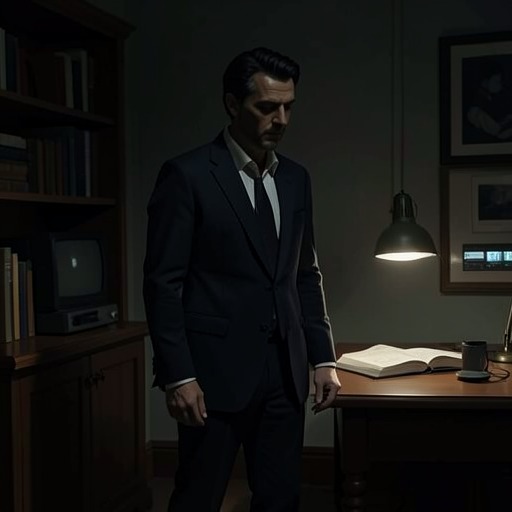
Mr Ramsay's 'Some one had blundered' episode
To the LighthouseMr Ramsay's 'Some one had blundered' episode is a brief scene of exposure and retreat: an impassioned performance that seems to restore Mr Ramsay's heroic grandeur collapses when Lily Briscoe and William Bankes encounter him, leaving his vulnerability visible even as he tries to hide it. The refrain first sounds like a cry from the past, then becomes the words with which Mr Ramsay names an unnamed failure; the scene's force lies in the collision between his inward rapture and the ordinary gaze of other people.
A performance gathers force
The episode begins as Mrs Ramsay sits reading with James. She has just understood that the conversation around her has stopped and, after a moment of tension, concludes that Charles Tansley has been left behind. Her attention settles again on her husband, whose measured movement up and down the terrace makes a familiar rhythm that reassures her. On her knee lies James's book, open to a picture of a six-bladed pocket knife that he must cut out carefully. This domestic quiet is the ground from which the sudden performance breaks.
Mr Ramsay's voice rises from the garden with the line “Stormed at with shot and shell”. He appears to Lily, who is painting on the lawn, as a figure charging forward, nearly knocking over her easel. Waving his hands, he cries, “Boldly we rode and well,” and then turns sharply away, as though riding onward toward death on the heights of Balaclava. The language and gesture enlarge the ordinary terrace into a scene of military heroism. To Lily, however, the effect is both ridiculous and alarming: his movement protects her from being watched, because while he is in motion he does not stop to inspect her painting.
Lily is intensely alert to the possibility of someone approaching and seeing her canvas. She keeps her attention on the mass, line, and colour before her while remaining watchful of her surroundings. When she senses footsteps, she recognizes William Bankes rather than turning the canvas toward the grass, as she might have done if the visitor were Charles Tansley, Paul Rayley, Minta Doyle, or almost anyone else. Bankes has seen her paint and knows her habits; their earlier exchanges about soup and the children, and their proximity in the village, have made them quiet allies. Their stillness beside the canvas makes Mr Ramsay's theatrical motion all the more conspicuous.
Witnessing the private crisis
Mr Ramsay's recital gathers its full significance when Lily and Bankes come through a gap in the high hedge and meet him. Following a flock of starlings scattered by Jasper's gun, they step directly into his path. Mr Ramsay booms, “Some one had blundered!” His eyes are glazed with emotion and defiance. For an instant he seems close to recognizing the two observers; then he raises a hand toward his face, as if to ward off their ordinary gaze and ask for a moment's privacy.
The narration presents the performance as more than a joke or an eccentric interruption. Mr Ramsay is both ashamed of his intense feeling and determined to keep hold of it. He turns abruptly and slams his private door, withdrawing from Lily and Bankes before their presence can fully break the spell. The starlings, meanwhile, settle on the tops of the elm trees. Their return to rest gives the scene a quiet exterior after the sudden disturbance, while the closed door marks the boundary Mr Ramsay needs between his private emotional state and the people who have seen it.
The words initially reach Lily and Bankes as an unexplained declaration. The birds and the exclamation draw them toward Mr Ramsay, but they cannot know what has provoked the cry. The scene therefore separates outward fact from inward experience: they witness his emotion and his retreat, not its complete cause. When Mrs Ramsay later hears the same words, she too has to work toward their meaning, understanding that something has happened without being able to identify what. The repeated phrase binds these partial encounters together without making the private crisis wholly transparent.
Mrs Ramsay's response
After the encounter, Mrs Ramsay is left to interpret her husband's approach. She fixes her short-sighted eyes on him and recognizes, from familiar signs—his averted eyes and the way he gathers himself inward—that he is outraged and anguished. She understands that he needs privacy in order to recover his balance. Rather than speaking to him about what she has perceived, she strokes James's head and transfers to the boy some of what she feels for her husband.
Her attention moves from distress toward the ordinary objects and hopes of family life. James is colouring a gentleman's white shirt from an Army and Navy Stores catalogue yellow with chalk. Watching him, Mrs Ramsay imagines how delightful it would be if he became a great artist, and thinks his splendid forehead might suit such a future. As Mr Ramsay passes again, she is relieved that his ruin seems veiled. The familiar pattern of domestic life resumes: he stops at the window, bends to tickle James's bare calf with a sprig, and Mrs Ramsay teases him for having sent the poor young man, Tansley, away. Mr Ramsay replies that Tansley had to go in and write his dissertation, then adds ironically that James will have to write his dissertation one day.
The exchange does not erase the earlier crisis; it shows how the household absorbs it. Mrs Ramsay does not demand an explanation or expose the emotion she has recognized. Instead, a gesture toward James, a teasing remark, and the familiar turn at the window allow contact to resume without forcing Mr Ramsay to account for his vulnerability. Her care works through discretion as much as through affection: she sees the wound, but does not make it public a second time.
The refrain and the limits of understanding
The phrase “Some one had blundered” moves through the episode in stages. It first arrives amid the heightened language of “Stormed at with shot and shell” and “Boldly we rode and well,” where it belongs to a heroic recitation. Then it becomes Mr Ramsay's loud cry before Lily and Bankes, an utterance charged by his emotion but unexplained to them. Finally, Mrs Ramsay repeats the words inwardly as she watches him approach, recognizing their importance while remaining unable to say what has gone wrong. Repetition carries meaning across different minds, but does not grant any one observer complete access to another's experience.
The episode's reversal is measured in social terms: Mr Ramsay seems momentarily to command the scene through voice and gesture, yet the arrival of two familiar people makes him conscious of himself as an object of observation. His raised hand, abrupt turn, and slammed door restore a barrier, but cannot undo the fact that Lily and Bankes have witnessed him. The performance thus reveals a tension between the force with which he stages his feeling and his need to conceal it. His public authority and private fragility are not separate states so much as two aspects of the same brief, exposed moment.